
Website Design for Mental Health Professionals: Tips & Inspo
You’re a mental health professional or a private practice owner ready to build your online presence, but you’re not sure where to begin. What should your site include? How do you make it stand out? What platform should you use?
Website design for mental health professionals comes with quite a few important decisions, and getting them right helps you attract the clients you want to work with. Here’s what you need to know!
How Do I Design an Effective Therapy Website?
As a brand & website designer, I’ve worked with many therapists and mental health professionals, and one thing I hear consistently is that they don’t want a website that feels cookie-cutter and generic.
They want a brand and website experience that matches their expertise and feels worth the investment, especially when their goal is to attract more private pay clients.
The best mental health professional websites clearly and cohesively communicate what you specialize in, who you serve, and what makes you unique as a practitioner. These elements help you come across as an expert in your field, rather than someone who threw together a website in their spare time.
In other words, your website should narrow in on the specific things that make you different and bring those qualities to the forefront in a visually appealing way.
It could be your therapeutic approach, the target audience you work with, your unique perspective, or expertise in specific modalities. Either way, whatever sets you apart needs to be visible and easy for your potential clients to understand on your private practice website.
Branding for Your Mental Health or Therapy Practice
Your therapist branding is the visual foundation of your practice. It typically includes:
- Logo and logo variations
- Color palette
- Fonts and typography
- Backgrounds, patterns, or illustrations
- Overall aesthetic and visual style
Strong branding reinforces what makes you unique and helps potential clients understand your approach and develop an idea of what it’s like to work with you.
You need solid branding in place before you dive into your website strategy and start designing your pages.
This will help your brand and website work together so that everything feels cohesive and builds trust with the people visiting your site. In fact, having consistent colors on your website helps potential clients recognize your practice 80% better!
What Is the Best Website Builder for Therapists and Mental Health Professionals?
A website builder lets you create and manage your website, and the platform you choose plays a big role in how unique and personalized your website can be.
I recommend Showit as the best website builder for therapists because it gives you complete design flexibility, and it’s also easy to update.
You can create a website that truly reflects your practice instead of being stuck with a template that looks like everyone else’s. Showit also has strong SEO features and integrates with WordPress for blogging, which helps potential clients find you through Google.
Other popular options for therapists include:
- Squarespace
- WordPress
- Wix
- Brighter Vision
- TherapySites
You’ll also need to think about HIPAA compliance for your website.
Most popular website builders aren’t inherently HIPAA compliant, but you can take steps to make certain aspects compliant (ex, contact forms) so that personal information is protected.
Learn more about creating a HIPAA-compliant website for your practice.
Design Process Questions to Consider
Here are some of the most common questions that come up when I’m working with mental health professionals on their website design:
1. Should I put each service on its own page?
Search engines like Google prefer to have one fully developed topic with useful, accurate information per page. For example, if you provide therapy for adolescents in Connecticut and therapy for couples in Connecticut, you can create two separate pages with unique content for each service.
Google is more likely to rank those individual pages for relevant searches than one general service page that just lists everything you offer.
That said, this approach depends on your budget for additional pages, your ability to write unique content for each service, and how competitive certain keywords are in your area.
Overall, creating separate service pages can be a great way to start showing up in more local searches.
If you’re considering a website design or redesign project and have questions about this strategy, reach out, and let’s talk through what makes sense for your therapist web design!
2. Should I let potential clients book their own consultation or email me first?
This is completely up to your preference and workflow! I’ve worked with clients who choose both options, so there’s no single right answer.
You can integrate a scheduling widget from SimplePractice that lets potential clients book directly, or you can use a HIPAA-compliant contact form where they reach out first, and you schedule a call after reviewing their inquiry.
Either option works! It just depends on how you want to manage your intake process.
3. How do I maintain HIPAA compliance on my website?
HIPAA compliance is a complex topic that involves keeping protected health information secure both on and off your website.
For the website design piece specifically, you need a HIPAA-compliant contact form.
I create HIPAA-compliant contact forms for mental health professionals using either Google Workspace or Microsoft 365 forms. This ensures that the information in client inquiries stays within a HIPAA-compliant environment.
I don’t recommend using the standard Showit contact form (or a contact form from other website builders, unless they’re therapist-specific) if you’re a therapist or mental health professional, as it’s not HIPAA-compliant on its own.
SimplePractice now adds a way to integrate HIPAA-compliant contact forms, but you can’t customize how they look visually, so that’s not my favorite option.
4. Should I list my pricing?
The vast majority of my therapist clients list their pricing so potential clients have an idea of cost before reaching out.
In general, I recommend this approach because it helps people determine fit early on.
It’s also helpful to list any insurance information that’s relevant, so visitors know whether you’re in-network with their provider or if you’re a private pay practice. This saves everyone time and makes the inquiry process smoother!
5. What happens if I am licensed in multiple states?
If you’re licensed in multiple states, like one of my clients, Integrative Psychotherapy & Wellness, your website strategy will largely depend on your budget and timeline.
If you have the budget, you can create dedicated pages for each service in each state, like adolescent therapy in New York, adolescent therapy in Connecticut, and so on.
This approach is thorough but can get expensive and labor-intensive quickly.
Most of my clients choose a middle-ground strategy, which is to create one fully developed page per service (like EMDR therapy or adolescent therapy) and list their licensed states on that page.
This way, you can start showing up in searches for those topics over time without the cost of building dozens of pages upfront.
You can always expand and add state-specific pages later as your practice grows for better search engine optimization.
Learn more about SEO for therapists and how you can use it to your advantage to get more clients from Google search results.
6. What happens when I need to make changes to the website over time?
I can help with this! I do website updates for many of my clients as their practices evolve and their needs change.
I also teach you how to make updates yourself during our time working together.
I create custom Showit tutorial videos that show you how to handle common updates like changing text, swapping photos, and adjusting other elements on your site. This way, you have the option to make quick changes on your own whenever you need to.
Learn more about me as your Showit website designer!
7. What do I do if I’m a therapist and a coach?
If you’re both a therapist and a coach, it’s generally a good idea to keep those two businesses separate, depending on your state’s laws and licensing requirements.
I can create distinct branding and websites for each business, so there’s no confusion or overlap between your therapeutic services and your coaching offerings. This helps you maintain clear boundaries and make sure that clients understand which service they’re receiving.
Learn more about whether a therapist can be a life coach and how to navigate this dual role, especially as it relates to website design + marketing your business online!
8. Should I have a blog?
I typically recommend including a blog, but only if blogging will actually be part of your marketing strategy and you’ll devote time to it (or hire a blog post writer to help!).
Blogging makes a lot of sense for addressing your potential clients’ symptoms, concerns, and life challenges in a long-form format.
It can also be excellent for SEO and helping people find you through Google searches.
However, if you’re only licensed in one state and want to target that state or certain cities within it, investing in individual service pages might be a better use of your resources than maintaining a blog.
9. How do I avoid having a website that looks generic?
It starts with unique and purposeful branding that feels aligned with your practice. Strong branding allows you to make your website an extension of that visual identity and create a cohesive brand experience for your clients.
For therapist branding specifically, it’s important to feel professional, aligned with your specialties, and unique.
You can accomplish this through interesting custom illustrations, unexpected color palettes, distinctive fonts, or thoughtful photography. All of these elements work together to create a memorable brand experience that sets you apart.
If you can hire a website copywriter (which I highly recommend if you have the budget!), they can help your words feel authentic and specific to your practice, too, instead of relying on generic language that could apply to anyone.
10. What pages should my therapy website include?
The pages you need depend on your services and how you want potential clients to learn about your practice.
Most therapist websites include a home page, an about page where you share your background and approach, service pages for each specialty, and a contact page.
If you offer multiple services or work with different populations, giving each one its own page helps visitors quickly find what they’re looking for. You might also want to include a resources page, an FAQ page, or a page about your fees and insurance.
That said, the most important thing is to make navigation simple and intuitive so people can easily understand how you can help them.
Examples of Websites for Mental Health Professionals
The Vibrant Tapestry
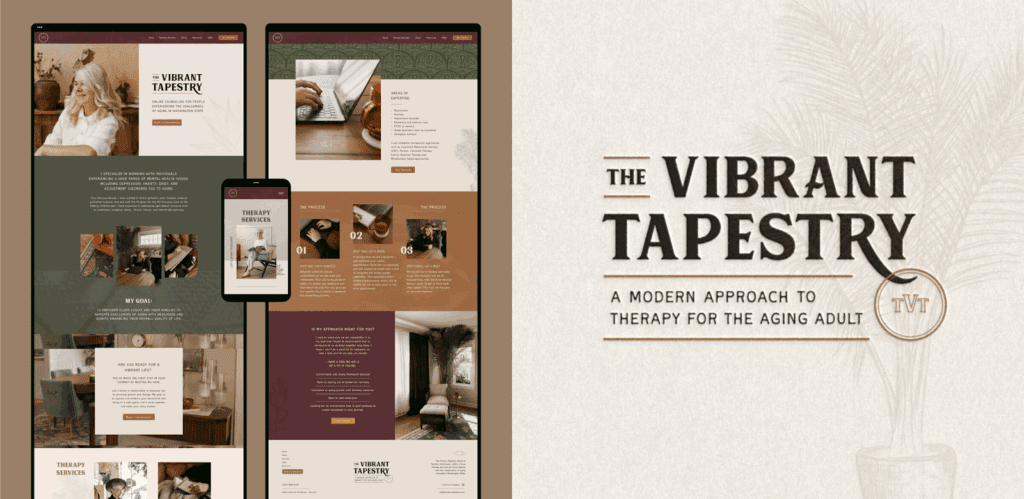
The Vibrant Tapestry is a therapy practice that serves a very targeted population: aging adults based in Washington state. Renee works with them to help navigate life’s challenges and honor their individual stories and experiences, all while supporting their growth.
I designed a vibrant and colorful brand and website that reflects Renee’s approach and immediately communicates the energy and intentionality she brings to her work.
Integrative Psychotherapy & Wellness
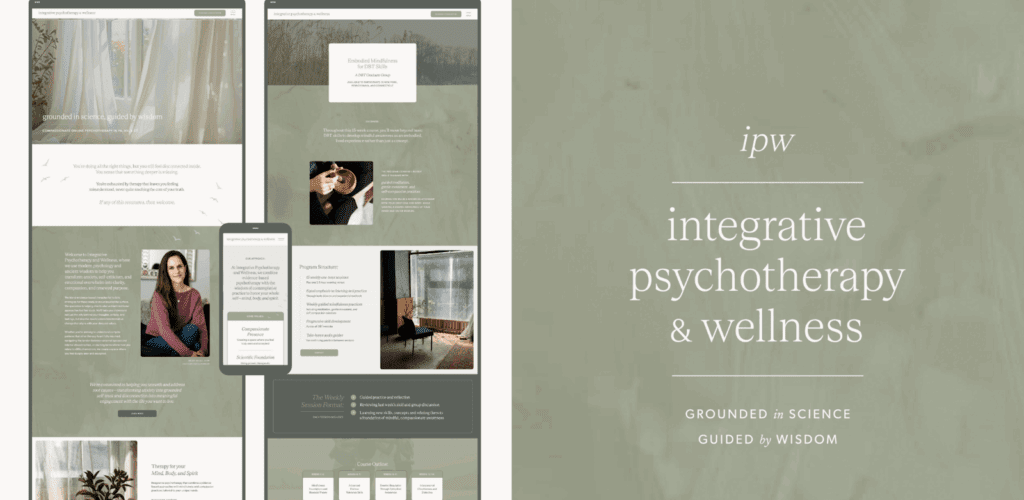
Hilary Bucell, LCSW, of Integrative Psychotherapy & Wellness, got in touch with me because she needed her website to boost her credibility and clearly communicate her expertise. Licensed in multiple states, she needed a website that made it easy for potential clients to understand her approach and see if she’s the right fit.
I designed her brand identity with custom illustrations and a Showit website that feels calming, grounded, and reflective of Hilary’s warm, professional presence.
Sequoia Therapy Group
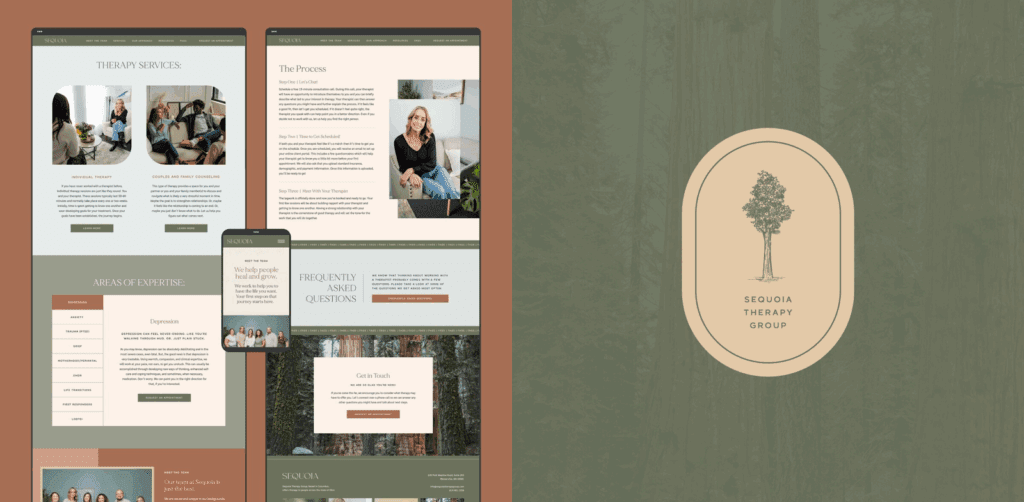
Sequoia Therapy Group serves a wide range of individuals, couples, and families in Columbus, Ohio, from mothers experiencing perinatal challenges to first responders dealing with job-related difficulties. This is a group practice, so the website needed to share detailed information about each therapist on the team.
I designed their brand and Showit website to feel warm, earthy, and welcoming, with symbolism rooted in the strength and resilience of the Sequoia tree. The site includes focused SEO optimization and a HIPAA-compliant contact form using Google Workspace.
Sage & Bloom Wellness
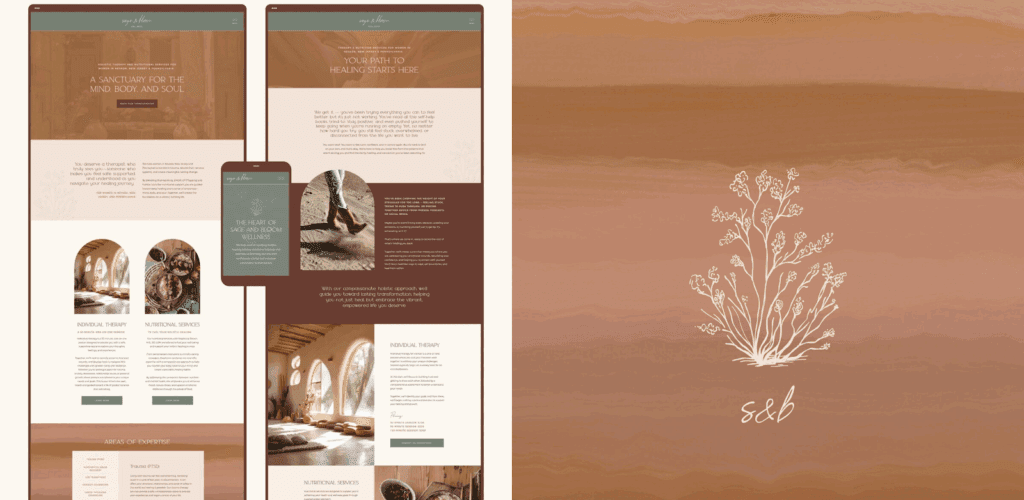
Sage & Bloom Wellness is a therapy practice for women that provides holistic therapy (including EMDR and trauma therapy) and nutritional services in Nevada, New Jersey, and Pennsylvania. Elizabeth wanted her branding and website to convey boutique sophistication, but also to reflect the practice’s holistic values.
I designed her brand and Showit website with warm, earthy, nature-inspired colors, backgrounds, and fonts that intentionally connect with her ideal clients and communicate a more holistic and earthy feel.
Jodi Berman, PhD

Jodi Berman, PhD, is a Westport, Connecticut-based therapist who supports clients throughout the state with challenges like anxiety, depression, motherhood, and major life transitions.
Jodi wanted to display a clean and sophisticated look and feel that matches what her ideal clients are looking for. We worked together to clearly show her expertise and specialties so someone can quickly scan her site and determine if she’s a good fit for them.
If you want more examples of website design for mental health professionals, take a look at these best therapist websites or my portfolio!
Get a Unique Website Design for Mental Health Professionals
If you want a beautiful & strategic website that reflects your expertise and connects with the clients you want to attract with your mental health services, I’d love to help.
You can learn more about my design services or get in touch to discuss your project!


