
Branding for Therapists: 7 Examples with Tips to Stand Out
For mental health professionals, branding might feel like something reserved for big corporations or influencers. But strong branding for therapists is essential to attract clients and position your private practice as the best place to support them.
As a Showit Design Partner, I specialize in crafting custom brands and websites for therapists and private practice owners that reflect who you truly are on a deeper level.
Here are my best tips to help you create irresistible branding for your therapy practice, along with a few real-life examples of branding for therapists!
What Is Therapist Branding?
Branding isn’t just pretty colors that you can use on your marketing materials. It runs much deeper than that. Your brand is the total of everything your business is, what it stands for, and how the world perceives it.
Your brand is your clients’ complete experience with your practice, from their first Google search to the moment they step into your office or log into their first virtual session.
So, before you even put pen to paper to design visual assets like a logo for your private practice, it’s essential to define a thoughtful strategy around your brand. Therapists should clarify their vision and mission by determining their core values and the types of clients they want to work with.
This is where many therapists don’t realize they should slow down to get so much more benefit out of their branding. They jump straight into the visual elements without first understanding their unique position in the mental health landscape.
Your brand identity should answer essential questions like:
- Who are the specific clients you’re best equipped to help?
- What makes your approach different from other therapists in your niche or area?
- What values guide your practice?
- How do you want clients to feel when they interact with you?
When you take the time to answer these questions first, you’re building a therapy brand that creates a genuine, deeper connection with your target audience, not just a pretty logo that sits on your business card.
Just take a look at these best therapist websites for examples of meaningful branding!
Why Branding for Therapists Matters
As a therapist, you work in a field where everything is built on trust and personal connection, so your branding should make your prospective clients feel safe reaching out for help. A thoughtfully curated brand reflects the type of environment clients can expect, helping them decide if it’s the right space for them.
Studies show that 81% of consumers need to trust a brand before they’ll even consider making a purchase. In mental health services, where trust is arguably more important than in many other industries, this statistic becomes even more significant.
Clients are sharing their most vulnerable thoughts and experiences with you, so they need to feel confident in their choice!
Other studies show that when clients form an emotional bond with a brand, their lifetime value increases by 306%. In therapy practice terms, this means clients who connect with your brand are more likely to:
- Complete their full course of treatment
- Return if they need support in the future
- Refer friends and family members
Marketing for therapists doesn’t have to feel overly commercial.
Instead, you should think of your marketing efforts as a way to authentically communicate who you are and how you can help so that more people improve their well-being.
Creating a compelling brand story helps therapists connect with potential clients on a personal level. Strong branding also helps clients feel like they belong, which is the foundation of any successful therapeutic relationship.
Ultimately, branding for therapists is all about making it easier for the right clients to find you and feel confident choosing you as their therapist.
6 Therapist Branding Examples
1. The Vibrant Tapestry
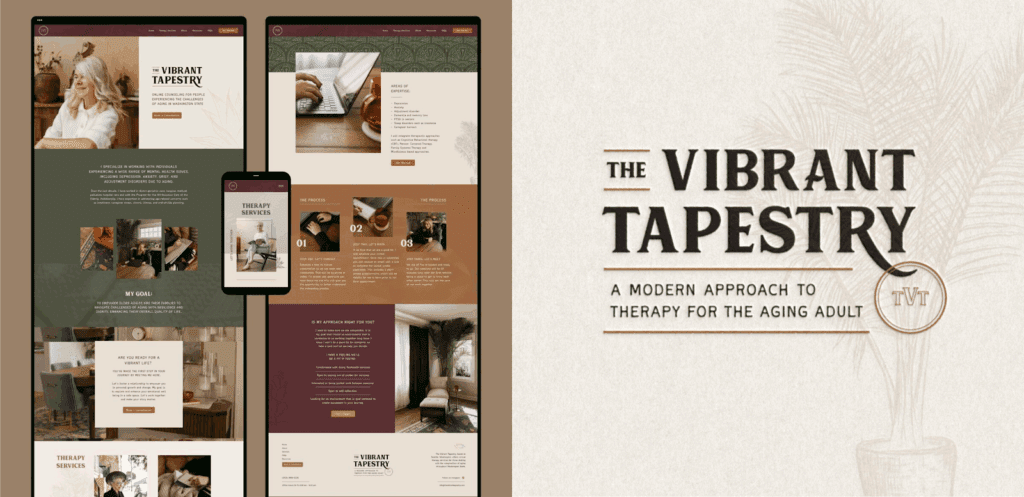
Renee, the Founder of The Vibrant Tapestry, is an online therapist for aging adults. Based in Washington state, Renee helps her clients honor their unique stories, perspectives, and complexities as they evolve through their life transitions.
Renee wanted The Vibrant Tapestry’s branding to feel warm and accepting, and she absolutely loved the final result!
2. Jodi Berman, PhD

Jodi Berman is a Connecticut therapist who helps her clients with major challenges, such as anxiety, depression, motherhood, and big life transitions. She wanted to start attracting more private-pay clients, and she knew that her branding would play a big role in that.
She wanted her brand to feel calm and clean, with an organic modern style.
I created a soothing neutral color palette of soft sage, warm beige, and cream tones paired with clean, elegant typography. The design uses natural textures and plenty of white space—the kind of visual breathing room that immediately puts potential clients at ease.
3. Integrative Psychotherapy & Wellness
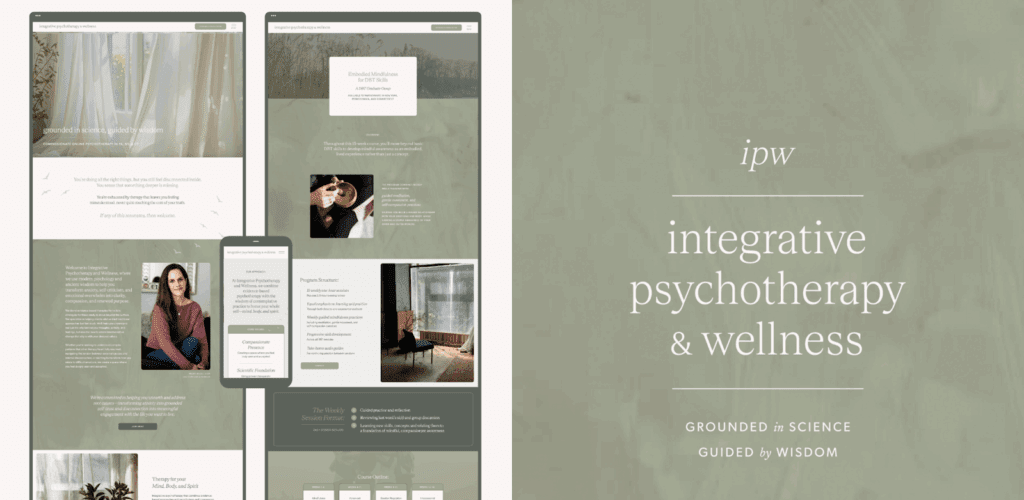
Integrative Psychotherapy & Wellness is an online psychotherapy practice.
It’s led by Hilary Bucell, LCSW, and the clients are from across Pennsylvania, New York, and Connecticut. Hilary had an ambitious vision when she got in touch with me, but her brand identity didn’t match it, and she was invisible online.
For her therapist branding, I came up with nature-inspired textures, an earthy color palette, and custom hand-drawn illustrations to create a sophisticated yet airy presence that attracted her ideal clients.
4. Community Connections Therapy
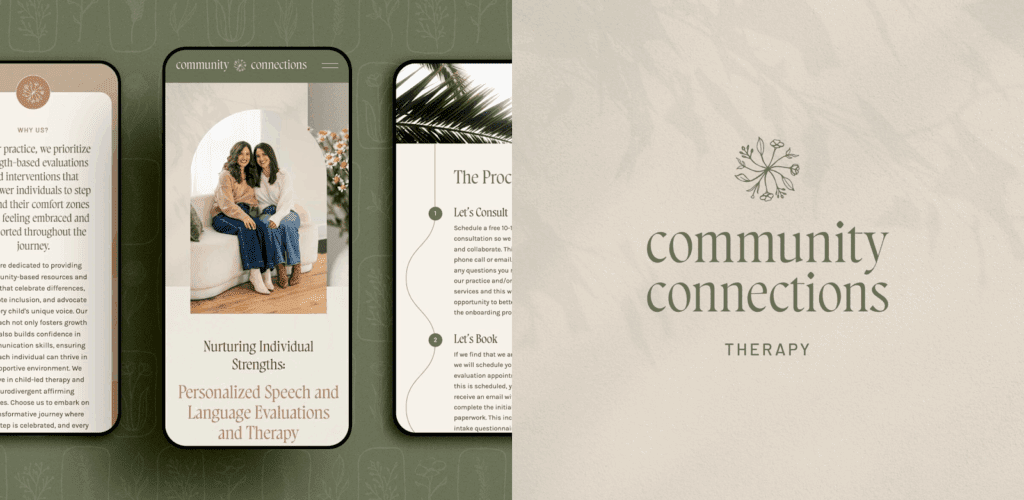
One of my favorite projects, Community Connections Therapy, is a speech therapy practice led by two twin sisters. They empower parents & children through education, speech therapy, and community involvement across Ohio.
Victoria and Christina wanted their branding to be earthy, welcoming, and a little boho-inspired.
I designed a warm color palette anchored by a rich olive green, complemented by soft terracotta and cream tones. The custom icon features botanical elements arranged in a circular pattern, symbolizing diversity, community, and growth.
5. Sage & Bloom Wellness
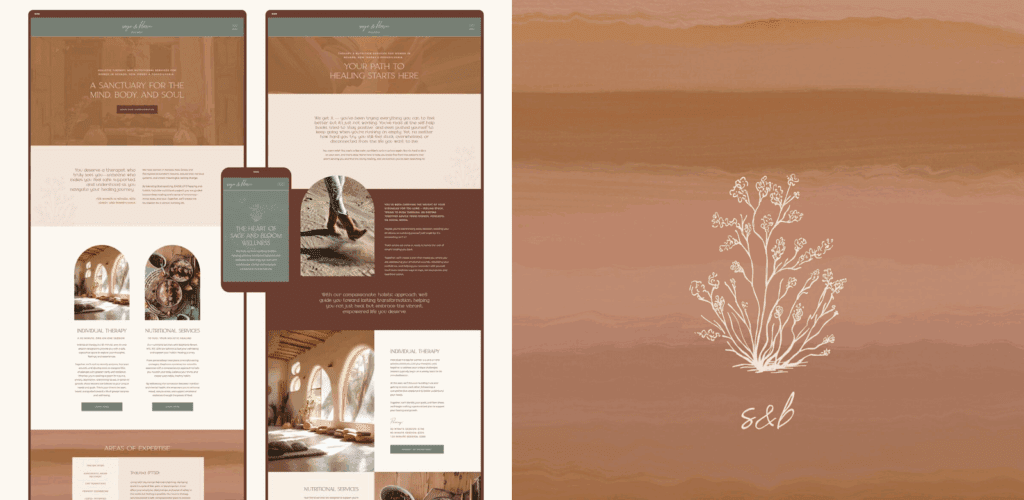
Sage & Bloom Wellness is a private therapy practice for women in Nevada, New Jersey, and Pennsylvania. It provides holistic therapy, including EMDR for trauma, and nutritional services to women who want to achieve emotional balance and live with a deeper connection to themselves.
Elizabeth, the owner, wanted her branding to reflect the practice’s holistic values, but at the same time communicate a sense of boutique sophistication. I designed an earthy yet elevated color palette of sage green, warm terracotta, and soft dusty rose, paired with elegant botanical illustrations.
6. Sequoia Therapy Group
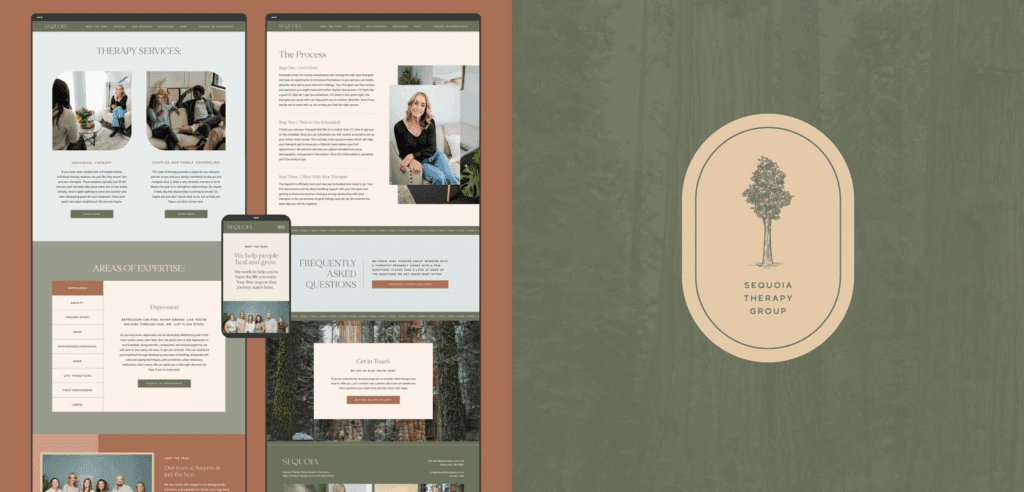
Sequoia Therapy Group is a private therapy practice that offers a wide range of services through its small team of dedicated providers. When they got in touch with me, their online presence was outdated, and they were looking to create warm, earthy, and welcoming private practice branding.
I created a nature-inspired color palette of forest green, warm terracotta, and soft cream that feels both grounded and inviting. The logo features a detailed illustration of a Sequoia tree framed by an arch, symbolizing the strength and resilience that the practice embodies.
Branding for Therapists: 10 Tips
When we talk about branding for therapists, it goes beyond choosing a color scheme and designing a memorable logo.
Your brand identity should create a genuine connection with your target audience on a deeper level, and here are my best tips on how to do that.
1. Define Your Target Audience
The first step to effective branding and a strong marketing strategy is a deep understanding of your target audience.
Decide who you want to work with—niching down can be hard, but it’s one of the best ways to make your private practice stand out!—and dig deep into their mindset and beliefs about themselves.
Creating client personas helps you better understand your clients and tailor your marketing to meet their needs. By visualizing who you’re speaking to in your branding and marketing efforts, you can craft messages that resonate more deeply with your ideal audience.
What do they care about? What are they struggling with? What do they want out of therapy? When you truly understand your ideal client’s mind, you can create a brand that speaks directly to their needs and desires for a stronger connection.
The more specific you can get with your niche, the more you’ll stand out.
Instead of being a ‘general therapist,’ position yourself as the go-to expert for a specific issue (like ADHD in adults) or a particular population (like LGBTQ+ teens). When clients see that you specialize in their exact struggle, they’re much more likely to choose you.
If you’re both a therapist and a life coach, which some of my clients are, you can also have different target audiences for each part of your practice.
2. Craft Your Unique Value Proposition
What sets your practice apart from other therapists? Your unique value proposition (UVP) is what makes your therapy practice distinctive and conveys why clients should choose you.
It might include your specialized training, a specific focus (ex, helping new mothers navigate postpartum anxiety), or a unique approach.
Being as specific as possible about your expertise helps potential clients understand exactly how you can help them.
The more developed your expression of your UVP is, the more private pay clients will be likely to choose you for processing their life struggle or challenge.
Consider starting a blog that addresses these specific areas. It’s a powerful way to demonstrate your expertise and connect with potential clients who are searching for help with these particular problems.
Not to mention it’ll improve your SEO (search engine optimization), so more potential clients can find you on Google!
3. Research Your Competitors
Take time to analyze other therapy practices in your niche or area and see how they market themselves. How do they speak to their audience? What does their brand look/feel like? What is their pricing? What are they doing well, and what could they improve on?
Therapy directories could be a good way to find competitors to research.
There are so many therapists out there, and researching them helps you understand the landscape and identify opportunities to creatively differentiate your practice. Don’t copy someone else’s positioning, even if you really like it. Instead, use it to figure out a unique space for yourself.
4. Create Your Visual Identity
Your visual identity should authentically reflect who you are and how you’re different from other therapists. A therapist’s visual identity typically includes:
- Your main logo and logo variations
- A defined color palette
- Fonts for headings and body copy
- Supporting design elements like patterns or icons
Visual identity also integrates aspects like color psychology and font psychology to communicate your brand’s personality.
I recommend you get professional help and work with a designer to create your therapist branding.
It’s not something you should DIY because it requires a lot of skill and knowledge. Working with a professional saves you time and lets you focus on what you do best, which is being a therapist, while creating a standout brand.
If your brand looks amateur and doesn’t instill confidence, it’s going to be more challenging to turn leads into new clients. In turn, clients often associate visual polish with expertise and are likely to trust you more when you have a strong visual identity.
Good branding helps you stay professional, creating a lasting impression and differentiating your practice from other counseling centers.
5. Build Consistent Messaging
25% of people recognize a brand by its unique voice. As you start to develop your website and social media presence, make sure that your branding and messaging are clear and cohesive throughout.
They should speak to your target audience in a specific way and use language that shows you understand their journey.
I always recommend working with a professional copywriter who understands the mental health space. They can help you find the right words that connect with your audience while staying true to your voice.
But if you prefer to write your own copy, I’ve got you covered! I share a detailed workbook with all my design clients that walks you through the messaging process step-by-step.
6. Establish Yourself as a Thought Leader
Content creation is a big part of running your own private practice (or any small business!).
Position yourself as an expert by creating valuable content and social media posts that showcase your knowledge and approach.
I can’t stress enough how much a blog can help you with this! It gives you the space to dive deep into topics relevant to your specialty. You can use blog content to educate your audience, prove to them that you understand their struggles, and establish yourself as a thought leader in your niche.
You can also use social media, podcasting, and email marketing. Another option is showcasing your expertise through client testimonials and case studies, but it’s important to ethically source them in a way that complies with HIPAA.
Whatever format you use, it’s essential to consistently position yourself as an expert who can help your target audience make real progress on their mental health and healing journey.
7. Pay Attention to SEO
SEO, or search engine optimization, is how potential clients can find you on Google.
If you offer virtual therapy services, SEO can help you connect with clients in your niche, whether it’s depression, anxiety, eating disorders, or other mental health focuses. If you have a physical office, local SEO is amazing for connecting with private pay clients in your area.
As the foundation, make sure that the SEO titles and meta descriptions on your website include specific keywords that match what your potential clients are searching for (ex, “anxiety therapist in [your city/state]”).
To continually build up your SEO over time and establish more authority on Google, start a blog and regularly publish high-quality content. There are also marketing agencies and SEO bloggers that can help you with this!
8. Explain Your Process and Approach
To establish trust and connect with the right clients, walk your audience through what working with you looks and feels like.
All therapists are different, so help your people self-identify by including a “We might be a good fit if…” section on your website. For example: “We might be a good fit if you’re ready to dive deep into childhood patterns and heal your trauma.”
You should also be transparent about the actual process of working with you.
Walk your potential clients through what happens when they inquire, what happens in the first session, how often you typically meet with clients, and what kind of progress they might expect.
9. Be Transparent About Your Pricing
Don’t make potential clients hunt for your fees! There’s nothing more frustrating than considering working with a provider, looking at their website to find out how much they charge, and realizing you’ll have to inquire to get that information.
So, be upfront about your rates and payment policies.
If you’re private pay only, explain the benefits this brings to the therapeutic relationship, such as better privacy and more flexible treatment options. Consider also including an FAQs section addressing common questions about insurance, sliding scales, and payment plans.
This makes your brand and website feel like a more welcoming environment with important information easily available.
10. Don’t Forget About HIPAA Compliance
Whether you’re an art therapist or offer talk therapy, an important part of your brand development should be making sure that your website and all materials you use in your practice are HIPAA-compliant.
One of the most important elements is having a HIPAA-compliant contact form on your website.
You can create one using Google Forms (with Google Workspace/Business Associate Agreement), Microsoft 365, or specialized software like SimplePractice.
Other elements of HIPAA compliance include:
- Secure email communication with encryption for any client correspondence
- A clear privacy policy on your website that explains how you handle protected health information
- Business Associate Agreements (BAAs) with any third-party services you use (like your website host, email provider, and scheduling software)
- Secure client portals for sharing documents or session notes
- SSL certificate for your website (the “https” in your URL)
- Password-protected systems for storing any client information
A thriving practice is a practice that complies with all requirements. Not only does HIPAA compliance protect your clients’ privacy, but it also protects you legally and builds trust with the people you serve.
FAQs
How can a therapist get more clients?
There are so many ways for a good therapist to market themselves more effectively to attract clients, but it all starts with building a strong brand identity first. You may not be getting as many clients as you want because you’re not expressing what makes you different from other professionals in an obvious way, or maybe your messaging is vague. So, start with defining (and refining!) your therapist branding.
Then, create targeted marketing for your audience. Create a professional website that clearly communicates your expertise and specialties, optimize it for SEO, and start regularly sharing relevant content through your blog. Market on social media to build a deeper, more personal relationship with your audience. Email marketing is also a powerful way to maintain contact with your audience and share valuable content.
Most importantly, focus on providing exceptional care to your current clients. Satisfied clients often become your best referral source through word-of-mouth recommendations.
How to market yourself as a therapist?
This is a nuanced question, but generally speaking, your marketing approach should balance professionalism with authenticity. Start by defining what your brand stands for, including your niche, unique value proposition, and brand messaging.
Then, find marketing channels that work and feel good to you. It could be social media, long-form content like podcasting and YouTube, email marketing, SEO, or a combination of different channels. The most important thing is that it’s something you can stay consistent with. You should also consider networking with other professionals and booking speaking engagements that align with your specialty and build trust with your audience.
Most importantly, make the mindset shift that marketing isn’t about ‘selling therapy’ but about making yourself visible and accessible to those who need your services.
Can therapists advertise on social media?
Yes, therapists can and should use social media, but it’s important to do so ethically and professionally. Focus on education and awareness—but make sure that it’s more personality-driven and not ‘dry’—and make sure to maintain clear boundaries. There can be a tricky line between educational content and giving out medical advice on the internet.
Instagram and LinkedIn are particularly powerful tools for therapists. Instagram is great for sharing relatable mental health content and building community, and LinkedIn is for professional networking and establishing thought leadership.
How do I choose a therapy niche?
Choosing a niche is always hard because it can feel narrow and limiting, but therapists who’re niched down typically see the most success because clients can immediately relate to them more than to a generalist. Your therapy niche should reflect both your expertise and your passion. Start by looking at your clinical experience. Which cases energize you? What types of clients do you connect with most deeply? You can also look for gaps in your local market—are there underserved populations or specific issues that few therapists in your area address?
Get Custom-Crafted Therapist Branding
Branding for therapists can be a strong foundation that attracts the right clients, communicates your value, and helps you make a lasting impact in your community.
When you take the time to develop it thoughtfully, you can create a private practice that truly resonates deeply with the clients you’re meant to serve. It shows that you’re the right therapist for them.
Learn more about my branding and website design services for therapists to tell your visual story and position yourself as the go-to expert in your niche. Or, browse my Portfolio!


