
Best Website Builder for Therapists: 7 Intriguing Options
As a website designer who regularly works with private practice owners, I often get asked: What is the best website builder for therapists?
A website builder is a tool that allows you to create a professional website with no coding. It usually provides pre-designed templates, drag-and-drop editors, and various features to customize the website to fit your needs. Most therapist websites are built using a website builder.
The good news is that there are many website builders out there. The bad news? There are MANY website builders out there, and it can be challenging to figure out which one is right for you.
I’ve experimented with lots of different platforms as part of client projects, so here’s my honest review of 7 different website builders for therapists.
Quick Preview of What to Expect:
- Platform Overviews
- HIPAA Compliance & Your Website Builder
- Why Showit Is the Best Website Builder for Therapists
- Therapist Website Examples Built on Showit
- Why It’s Important to Have a Professional Website
- Hiring a Designer vs. DIY
What Is the Best Website Builder for Therapists?
- Best Overall: Showit | Read my full review
- Most Affordable: WordPress | Read my full review
- Therapist-Focused: TherapySites | Read my full review
- Easy to Use: Squarespace | Read my full review
- Not My Cup of Tea: Brighter Vision | Read my full review
- Beginner-Friendly: Wix | Read my full review
- All-in-One Practice Management: SimplePractice | Read my full review
1. Best Overall – Showit
My Rating: ⭐⭐⭐⭐⭐ (5/5)
Showit is an intuitive, drag-and-drop website builder that has gained a lot of popularity with creative entrepreneurs and small business owners because of its unmatched creative freedom and beautiful designs. It works really well for therapists and private practices, too.
Pros & Cons
Pros:
- Unlimited creative freedom with zero design restrictions
- Separate mobile-responsive design (not just auto-optimized)
- Strong SEO capabilities with WordPress blogging integration
- Easy integration with client portals and scheduling tools
- Helpful customer support team
Cons:
- Limited e-commerce functionality
- Requires annual billing for best pricing
- Not inherently HIPAA-compliant (but you can create HIPAA-compliant contact forms)
Cost
Showit pricing starts at $22/month when billed annually. The basic plan doesn’t include SEO blogging tools. If you want a blog on your therapist website, the Showit & Basic Starter Blog Plan is $27/month (billed annually), and the Showit & Advanced Blog Plan is $39/month (billed annually).
You can use my referral link to get a free month on Showit!
Overview
I’m a Showit Design Partner, and Showit is my platform of choice for all of my therapy clients. There is genuinely no comparison between Showit and other website builders in terms of creative freedom and how aesthetically pleasing your entire website can be.
One of my favorite features of this site builder is that you can design a separate mobile version of your website, not just an auto-optimized version that often ends up clunky. Since more than half of your website visitors browse on their phones, this feature alone can make or break your ability to convert potential clients.
2. Most Affordable – WordPress
My Rating: ⭐⭐⭐ (3/5)
WordPress is a long-standing website builder known for its affordability and powerful SEO capabilities, but you’ll need many themes and plugins to customize your therapy website.
Pros & Cons
Pros:
- Very affordable—free plan available, paid plans start at $4/month
- Strong SEO capabilities
- Thousands of themes and plugins
- Flexible e-commerce capabilities
- Free domain registration is included with paid plans
Cons:
- It will be confusing without technical or coding experience
- May require hiring a developer for changes and updates
- Limited creativity compared to other builders
- Websites can look outdated
Cost
WordPress is one of the most affordable website builders for therapists. There is a free plan (though it can be quite limiting) and paid plans start as low as $4/month when billed annually and include a free domain for one year.
Overview
WordPress has been around forever, and many therapists still choose it as their website builder. It excels in search engine optimization (SEO) and has many different plugins and themes you can use.
However, there’s a significant downside: the learning curve is steep, and you’ll likely need some technical knowledge to make it work the way you want. If you don’t know how to code, you’ll probably end up hiring a developer even for small changes, which can be costly and frustrating over time.
3. Therapist-Focused – TherapySites
My Rating: ⭐⭐ (2/5)
TherapySites is a website builder exclusively for therapists, and it comes with built-in features like HIPAA-compliant scheduling and therapist-developed content. However, the website-building features are quite outdated and clunky, which makes attracting clients difficult.
Pros & Cons
Pros:
- Built for therapists with their unique needs in mind
- HIPAA-compliant online appointment scheduling included
- 6-month free directory listing in Psychology Today
- Integration with email marketing and third-party tools
Cons:
- Outdated and clunky design
- Very limited customization options (only a few themes available)
- Expensive at $69/month for the all-in-one package
- Difficult migration process if you want to switch platforms later
- Restricted access to DNS settings can complicate domain transfers
Cost
TherapySites offers one all-in-one package for $69/month. It includes a 6-month free directory listing in Psychology Today, web hosting, client management tools, and online appointment requests.
Overview
IMO, TherapySites websites end up looking outdated compared to other private practices. The customizable templates don’t offer much flexibility, and it’ll be hard to make your site reflect your personality and brand. At $69/month, it’s also one of the more expensive options on this list.
In my experience helping clients switch from TherapySites to other platforms, the migration process can be challenging. TherapySites sometimes restricts access to important DNS settings, which makes transferring your domain more complicated. I’ve had to reach out to their customer support to get assistance during these transitions, and honestly, Showit’s team was way more efficient and helpful.
4. Easy to Use – Squarespace
My Rating: ⭐⭐⭐⭐ (4/5)
Squarespace is a popular website builder with a user-friendly interface and professionally designed templates that make it easy to create a visually appealing website without any coding knowledge.
Pros & Cons
Pros:
- Beautiful, modern templates that are professionally designed
- User-friendly interface with no coding required
- Free custom domain included with subscription
- Much more visually appealing than WordPress or TherapySites
Cons:
- Limited customization compared to Showit
- Weaker SEO capabilities than Showit and WordPress
- Limited blogging functionality
- Contact forms are not HIPAA-compliant
Cost
Squarespace is priced similarly to Showit and comes with a free 14-day trial. When paid annually, the lowest plan starts at $16/month. The subscription includes a free custom domain.
Overview
Squarespace is relatively easy to use for mental health professionals with an intuitive user interface, and the templates & designs are definitely a step up from WordPress and TherapySites. However, customization options can still be somewhat limited.
Squarespace also has weaker SEO and blogging capabilities compared to Showit and WordPress, and the contact forms aren’t HIPAA-compliant, which is a consideration for therapists. If you need clients to schedule appointments directly on your website, you’ll need to use HIPAA-compliant scheduling plugins.
5. Not My Cup of Tea- Brighter Vision
My Rating: ⭐⭐ (2/5)
Brighter Vision is a therapist-specific platform that offers a done-for-you website design service, meaning their team handles the entire design and setup process for you.
Pros & Cons
Pros:
- Designed specifically for mental health professionals
- Done-for-you service saves time on design and setup
- HIPAA-compliant, encrypted emails included
- Appointment scheduling features are built in
- Premium subscription includes the Social Genie marketing tool
Cons:
- Generic, outdated design that could belong to anyone
- Very expensive ($99-$349/month depending on features)
- Ongoing subscription is required to maintain your website
- You lose access to your website if you cancel
- Add-ons like Google Ads and HIPAA emails cost extra
- Little control over customization since they handle design
Cost
Brighter Vision pricing starts at $99/month and goes up to $349/month if you want access to all of the platform’s features. Add-ons like Google Ads and HIPAA-compliant emails are extra. You must maintain your subscription to keep your website active, so you’ll lose your website if you stop paying.
Overview
One of the main differences between Brighter Vision and other builders is that their team actually designs your website. This can save you time and lower your expenses, but it also means you have to really love Brighter Vision’s design style. Personally, I find their web design to be generic and a little outdated.
The websites they create aren’t bad, but they could belong to virtually anyone. For best marketing results, you want unique therapist branding that forges a deep emotional connection with your target audience, and that’s hard to achieve with Brighter Vision’s templates.
6. Beginner-Friendly – Wix
My Rating: ⭐⭐⭐ (3/5)
Wix is a beginner-friendly website builder with an easy drag-and-drop editor and hundreds of templates, but it doesn’t have any therapist-specific features.
Pros & Cons
Pros:
- Intuitive drag-and-drop editor
- Hundreds of templates to choose from
- Affordable pricing options
- App marketplace for adding features and functionality
Cons:
- Templates can feel generic and overused
- Limited design flexibility once you choose a template
- Weaker SEO performance compared to WordPress and Showit
- Contact forms are not HIPAA-compliant
- Can look less professional than other options
Cost
Wix offers a free plan with Wix branding and ads. Paid plans start at around $17/month when billed annually and include a free custom domain for the first year. Premium plans can go up to $159/month.
Overview
Wix has a relatively straightforward drag-and-drop editor, plus tons of templates to choose from. However, once you pick a template, you’re pretty much locked into that structure. You can’t easily switch templates without rebuilding your entire site.
The design options also feel more limited compared to Showit, and many Wix websites end up looking similar to each other. While Wix has built-in SEO tools, the platform doesn’t perform as well as WordPress or Showit when it comes to search engine rankings. Contact forms aren’t HIPAA-compliant, so you’d need to integrate third-party solutions.
7. All-in-One Practice Management – SimplePractice
My Rating: ⭐⭐⭐ (3/5)
SimplePractice is primarily a practice management software that also offers website building as part of its all-in-one platform, so you’ll be able to manage scheduling, billing, and your website in one place.
Pros & Cons
Pros:
- All-in-one solution
- HIPAA-compliant features built into the platform
- Client portal and telehealth services included
- Easy for clients to book appointments directly from your site
Cons:
- Very limited design options and customization
- Websites often look basic and templated
- More expensive than standalone website builders
- Website is tied to your practice management subscription
- Not ideal if you want a unique, branded website
- Limited SEO capabilities
Cost
SimplePractice doesn’t offer website building as a standalone service. It’s part of their practice management subscription. Plans start at $49/month, and go up to $99/month depending on your practice needs. The website feature is included in all plans.
Overview
You may already know SimplePractice as a practice management software. The website builder is more of an add-on feature than a standalone product. The main advantage of this platform is convenience, since everything lives in one place.
If you’re already using SimplePractice for practice management and just need a very simple website to get started, it can work. But if you’re opening your own therapy practice and want a website that helps you stand out, SimplePractice isn’t the best choice. You’re better off using a dedicated website builder like Showit and integrating it with SimplePractice for scheduling.
HIPAA Compliance & Your Website Builder
As a therapist or a private practice owner, you should build a HIPAA-compliant website, but not all website builders handle this the same way.
With general-purpose website builders like Showit and Squarespace, website elements like your contact forms aren’t inherently HIPAA-compliant.
However, you can create HIPAA-compliant forms using Google Forms (only if you have Google Workspace) or Microsoft 365. I regularly create HIPAA-compliant contact forms for my Showit clients using this method, along with custom CSS code to match their branding!
Website builders that only focus on therapists, such as TherapySites, Brighter Vision, and SimplePractice, typically have HIPAA-compliant forms built into the platform. The trade-off is that these forms may not match your branding as well, and you have less control over customization.
Beyond contact forms, here are a few other HIPAA considerations for your website:
- Don’t collect protected health information (PHI) through your website: Keep forms focused on basic contact information and appointment requests.
- Use secure, encrypted connections: Make sure your website has an SSL certificate (most modern website builders include this).
- Choose HIPAA-compliant scheduling tools: If clients book appointments through your site, use tools like SimplePractice or other platforms that offer Business Associate Agreements.
- Be mindful of third-party integrations: Analytics tools, chatbots, and marketing pixels may not be HIPAA-compliant.
I’m not a lawyer, so this isn’t legal advice. It’s a good idea to consult an attorney in your state to make sure your website is fully HIPAA-compliant.
Why Showit Is the Best Website Builder for Therapists
After working with multiple platforms, I genuinely believe Showit is THE best website builder for therapists. It strikes a balance between beautiful designs, technical support, and ease of use, and it’s not particularly expensive compared to other options out there.
While it doesn’t have therapist-specific templates or built-in marketing tools, you can integrate everything you need pretty easily:
- Client portals and scheduling systems: You can add links to SimplePractice, TherapyNotes, Acuity, or any other client portal directly into your website.
- HIPAA-compliant contact forms: Using Google Workspace or Microsoft 365, you can create forms that meet HIPAA requirements while matching your branding.
- Telehealth platform links: Whether you use SimplePractice video or another platform, you can add buttons and links wherever they make sense on your site.
- Insurance and payment information: You have complete freedom to design your services pages with clear pricing, insurance details, and payment options in a way that feels authentic to your practice.
- Psychology Today and directory listings: You can link to your Psychology Today profile or other therapist directories right from your website.
- Creative freedom: Showit’s website builder allows you to portray your practice online in a way that feels special and unique to you, vs. a template that could apply to anyone.
Plus, the WordPress integration gives you powerful SEO tools to share mental health resources and help clients find you on Google, and Showit’s customer support team is super responsive and helpful.
Therapist Website Examples Built on Showit
Jodi Berman, PhD

Jodi Berman is a Westport-based therapist who supports clients throughout Connecticut through challenges like anxiety, depression, and major life transitions (including motherhood).
She wanted her website to feel clean & calm, so I designed grounding branding and made it come to life on Jodi’s new Showit website. Her website includes a detailed overview of her professional services and a HIPAA-compliant contact form.
Integrative Psychotherapy & Wellness

Hilary Bucell, LCSW, runs a psychotherapy practice and serves clients across Pennsylvania, New York, and Connecticut. She started her own solo private practice and wanted her online presence to communicate the feelings of warmth and professionalism.
I created nature-inspired textures, hand-drawn illustrations, and a serene, earthy color palette to visually communicate Hilary’s approach and help her potential clients feel emotionally safe. There’s a HIPAA-compliant integration to facilitate online bookings as well as a contact form.
Sequoia Therapy Group

Sequoia Therapy Group is a private practice in Columbus, Ohio. They wanted their website to have a warm, earthy, and welcoming atmosphere while looking polished.
During this project, we put a big emphasis on SEO to help Sequoia come up in Google searches more often. I also designed their contact form to be HIPAA-compliant using Google Workspace!
Sage & Bloom Wellness

Sage & Bloom Wellness is a private practice for women in Nevada, New Jersey & Pennsylvania. Their focus is on holistic therapy (including EMDR and trauma therapy) and nutritional services.
The owner, Elizabeth, wanted the practice’s branding and website to feel boutique and sophisticated while also reflecting their holistic values. I designed it to be earthy yet refined to emotionally connect with Sage & Bloom’s target audience.
This website features a client portal linked from the footer, as well as a HIPAA-compliant contact form I created using their Google Workspace account and custom CSS code!
The Vibrant Tapestry
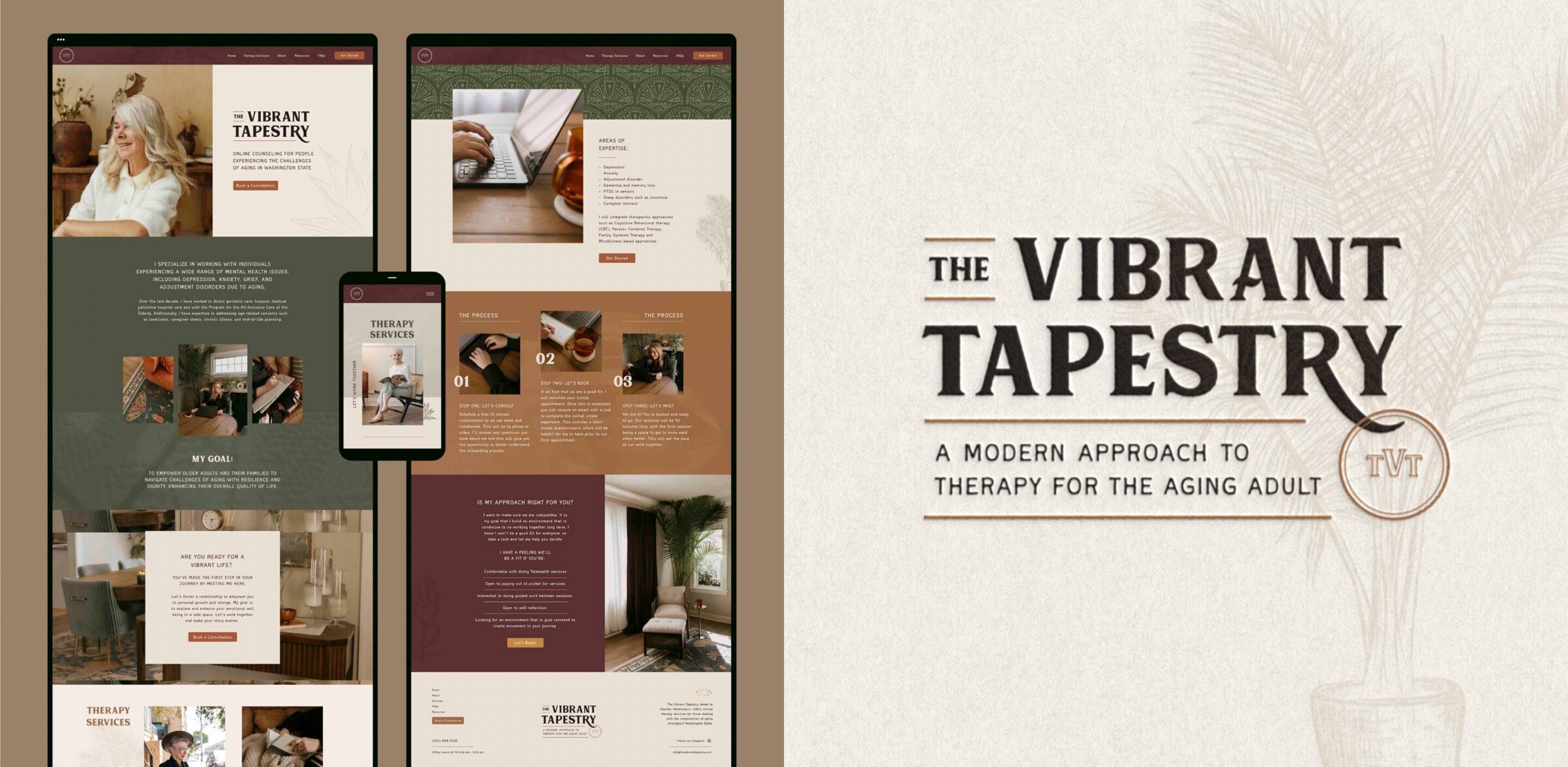
One of my favorite client projects to date, The Vibrant Tapestry, is an online therapy practice for aging adults in Washington state. The Founder, Renee, is on a mission to help her clients honor their unique stories, perspectives, and complexities as they grow older.
I designed The Vibrant Tapestry’s branding and website to feel warm and accepting. At the same time, I made sure that the structure of the website was easy to follow, and Renee’s prospective clients could quickly find everything they needed to get started. There’s also a HIPAA-compliant contact form I created using her Google Workspace account and CSS code.
If you’re looking for more examples, take a look at these best therapist websites!
Why It’s Important to Have a Professional Therapist Website
Creating a compelling and professional website helps you attract potential clients, build trust with your target audience, and confidently grow your brand.
If you’ve ever been asked, “Can I get a link to your website?” and felt uneasy about it, creating a therapist website that you’re truly proud of can turn this question into the highlight of your day.
Here are a few other reasons why having a professional website matters:
- SEO helps clients find you: When potential clients search for therapists in your area or your specific services, a well-optimized website helps you show up in search results.
- You control your narrative: Psychology Today profiles are helpful, but your website lets you share your approach, personality, and values more authentically.
- It builds credibility: A professional website makes you appear more established and trustworthy, even if you’re just starting your own practice.
- You can showcase what makes you different: Whether it’s your therapeutic approach or the populations you serve, your website lets you highlight what sets you apart.
- It makes scheduling and contact easier: A clear, accessible website makes it simple for clients to reach out or book appointments.
Launch your website as soon as possible! Some therapists think they need to wait until they have more clients or everything is figured out, but creating a website helps you build a cohesive brand identity and appear more established from the start.
Hiring a Designer vs DIY
You have two main options to get your website up and running: 1) use a template and 2) hire a professional designer. In most cases, I recommend hiring a pro (like me! 👋) to design a custom therapist website from scratch.
Most website builders offer pre-designed templates that you can customize yourself.
This is an affordable option (a website template typically costs between $200 and $600), and there are many templates to choose from. You just need to select one that closely matches your vision, then modify colors, fonts, and content to align with your brand.
But, of course, there are downsides:
- It’s a lot of work (like, a LOT)
- You need to be relatively tech-savvy
- Your site might look similar to others
This is why many therapists hire a professional designer to build their website. I honestly don’t really recommend DIY-ing because it takes a lot of effort, the result is usually not what you truly want, and many therapists end up hiring a designer eventually anyway.
Your website designer can also assess and recommend which website builder is best for your private practice. Many website designers specialize in one or two platforms. For example, I only use Showit because I genuinely believe that it’s the best platform for therapy practices!
When you use my design services, I’ll design a custom Showit website completely from scratch and create therapist-specific elements, such as HIPAA-compliant contact forms.
The design is fully personalized to your services and goals, so you get exactly what you want, and I’ll film helpful tutorials on how to easily manage your new website in the long run!
Final Thoughts
There are many website builder options out there for therapists, each with its own strengths and trade-offs. However, I believe Showit is the best choice for therapists who want a beautiful, functional, and unique website that helps them attract ideal clients.
If you’re ready to create a therapist website you’re proud of, I’d love to help! Learn more about my design services for therapists or get in touch. You can also take a look at my Portfolio!


