
Health and Wellness Website Design: 7 Steps to Stand Out
If you’re a health and wellness professional looking to grow your practice, your website is where that starts. But health and wellness website design can feel overwhelming.
You want to look polished and professional without feeling rigid or sterile. You also want to look human and warm, but not overly soft, vague, or fluffy.
Intentional branding and strategic web design help you find that balance. Here’s how to get it right and build a well-designed website that attracts clients, explained by a brand & Showit website designer!
Why Website Design for Health and Wellness Professionals Matters
Health and wellness is a space where trust matters perhaps more than in any other industry.
People looking for a therapist, nutritionist, medical professional, or any kind of practitioner are often navigating health concerns, whether they’re physical or mental. Your website is typically the first place your potential clients go to figure out if you’re someone they can trust with something that important.
In fact, 75% of people judge a website’s credibility based on its design alone, and 48% say design is the single biggest factor in whether they trust a business.
A well-designed website helps you:
- Communicate your expertise so the right clients find and resonate with you
- Build credibility
- Differentiate your practice from other practitioners in your area or niche
- Create a seamless experience
Your website is the one place online where you get to fully shape the narrative around who you are, what you do, and why someone should choose you.
Learn more about website design for mental health professionals.
7 Steps to Meaningful Health and Wellness Website Design
1. Craft your brand identity
Before you design your health and wellness website, you need a brand identity in place. And I don’t mean just picking a few colors you like and calling it a day!
Your brand identity starts with strategy. This means clarifying:
- Your mission
- Your core values
- Who you serve
- How you’re positioned in your market
- What makes your practice different from the other options
These foundations inform everything else.
Your visuals, such as your logo, color palette, fonts, illustrations, and photography style, should be a meaningful reflection of that strategy rather than a collection of things that look nice but don’t ultimately communicate something that connects with your people.
For health and wellness branding specifically, you should also pay attention to legibility, contrast, and font sizing. Depending on the population you serve, your clients may need higher contrast text, larger fonts, or other accessibility accommodations.
This is especially relevant if you work with older adults, people managing chronic conditions, or anyone who might have visual or cognitive accessibility needs.
If additional ADA compliance and accessibility are a concern for your practice, you can also add a widget to your site, like UserWay or accessiBe, to give visitors more control over how they experience your content.
2. Choose your website builder
A website builder is the platform you use to create, design, and manage your website.
It affects how much creative control you have over your design and how well it can support things like SEO and integrations for your private practice website.
My recommended website builder for health and wellness professionals is Showit.
It gives you complete design freedom, and you’re not locked into limited layout options. Showit also integrates with WordPress for blogging, which is a big plus if SEO is a part of your growth strategy. And it’s easy to update on your own once your site is live!
Other website builders that are popular in this space include:
- Squarespace
- WordPress
- Wix
- Brighter Vision (for therapists)
- TherapySites (for therapists)
Each has its pros and cons, but if design flexibility and a unique look are priorities for you, Showit is where I’d point you.
If you’re a therapist or a mental health professional, learn more about the best website builder for therapists.
3. Invest in quality visuals
You can have a solid website design, but to communicate quality, you also need high-quality imagery. Photos and imagery carry a lot of weight and can either reinforce or undermine the credibility you’re trying to build.
If you have the budget, do a professional photo shoot.
Get high-quality headshots of yourself and your team, and if possible, get some lifestyle or environmental shots that reflect the experience of working with you. People want to see who they’ll be working with!
If a photo shoot isn’t in the cards right now, use high-quality stock photography from websites like:
You can also use a mix of both professional photography and stock images. This is what many of my website design clients end up doing to have some variety!
4. Decide on your website pages
Your health and wellness website design must have a clear structure. A beautiful site that’s confusing to navigate or missing key information isn’t going to convert visitors into clients!
The pages I typically recommend for health and wellness professionals are:
- Home
- About
- Services
- Individual service pages, if applicable
- FAQs
- Insurance/Fees
- Resources
- Blog
- Contact
If you’re just starting out and that list feels like a lot, focus on the must-haves first, which are Home, About, Services, and Contact. You can always build out from there as your practice grows!
Building out individual services pages is often a good move if you offer different types of services or serve different geographic areas and want SEO (search engine optimization) to work for you.
Having a dedicated page for each service or location gives you greater chances of ranking, but many of my clients build it out gradually over the years. You don’t have to tackle it all at once!
5. Don’t forget about HIPAA compliance
If your practice is bound by HIPAA—and if you’re a physician, nurse, therapist, or any other healthcare provider, it likely is!—your website needs to account for that.
There are many steps involved in building a HIPAA-compliant website, but from a web design standpoint, one of the most critical pieces is your contact form.
Any form on your site where someone could submit protected health information (contact forms, intake forms, consultation requests) needs to be HIPAA compliant.
Standard contact forms that come built into most website builders are not HIPAA-compliant on their own.
I set up HIPAA-compliant contact forms for my clients using Google Forms through Google Workspace or Microsoft 365, both of which can be configured to meet HIPAA requirements.
I can also connect your SimplePractice contact form if you use SimplePractice!
I’ve written in-depth guides on both of these if you want to understand how they work:
This is something I implement as part of my website design process for health and wellness clients, so if you’re working with me, you don’t have to figure it out on your own.
6. Add disclaimers
If your website includes any content related to personal health, medical decisions, treatment options, or medical opinions, you likely need appropriate disclaimers in place.
Be thoughtful about the claims you’re making on your site and where you might need to clarify that your content is educational, not a substitute for professional medical advice.
The specific language you need will depend on your field, license, and state’s regulations. I recommend consulting an attorney who understands your industry to get this right. If you are licensed, make sure everything on your site stays within the boundaries of your licensure!
7. Make it clear
Beautiful design and compelling messaging matter, but they need to serve a purpose.
Your website should make it effortless for someone to find the most important information and take the next step.
This sounds simple, but it can be tricky. To guide visitors effectively, put yourself in your potential client’s shoes. They’re probably coming to your site with questions like:
- How much does this cost?
- Do you take my insurance?
- Where are you located?
- How do I book?
- Can I see you virtually?
Make that information easy to find! Here are a few tips on how to create a clean design for your ideal clients:
- Show your pricing and insurance information clearly so visitors don’t have to dig for it
- Include an FAQ section or page that addresses the concerns you hear most often
- Display your office hours, location, phone number, and email in your footer or contact page so they’re accessible from anywhere on your site
- Give visitors an obvious way to book or get in touch, such as a HIPAA-compliant contact form or a scheduling widget through SimplePractice, Jane App, or a similar platform
- Highlight your credentials, certifications, media features, or published work to build credibility (especially if you’re not using client testimonials)
- Use clear calls to action on every page so someone always knows what to do next
Your website also needs to look and function well on mobile devices.
A large portion of your visitors will be browsing on their phones, and if the experience feels clunky or hard to navigate on a smaller screen, they’re likely to leave.
Health and Wellness Website Design Examples
If you’re looking for health and wellness website design inspiration, here are a few examples from my portfolio!
Concierge Health Partners of The Woodlands
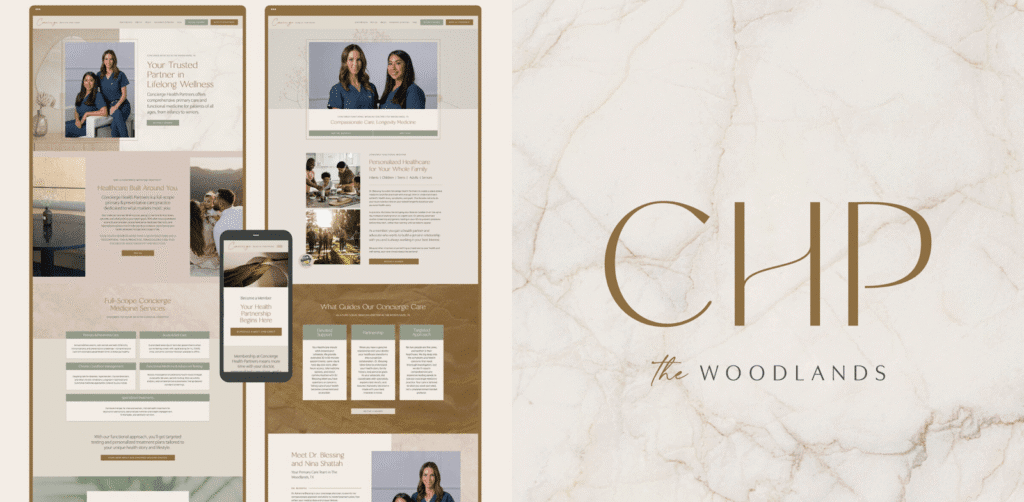
Concierge Health Partners is a private family practice offering concierge primary care and functional medicine services in The Woodlands, Texas. The brand and website needed to feel elevated and professional while still reflecting the warm and organic aesthetic of their physical office space.
I designed the brand identity with soft sages, warm neutrals, and clean typography to strike a balance between earthy and elegant. The Showit website is SEO-optimized and includes a HIPAA-compliant contact form, with simple navigation that makes it easy for prospective members to learn about the practice and take the next step!
Rise Neuro Rehab
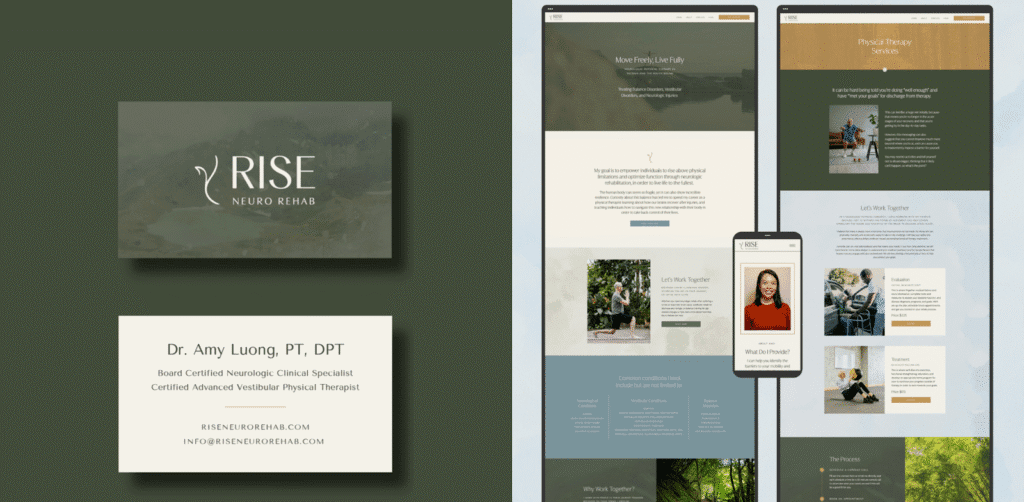
Rise Neuro Rehab is a physical therapy practice in Tacoma, Washington, specializing in neurologic physical therapy, balance, and vestibular rehab.
Amy, the owner, needed a brand and website that felt optimistic and calming while also being inclusive and gender-neutral, since she serves a wide range of individuals.
I designed the brand with minimal, flowing elements and an earthy color palette inspired by the natural beauty of the Pacific Northwest. The website creates a grounded, welcoming experience that reflects the sense of possibility at the core of her work. It also features a HIPAA-compliant contact form.
Jodi Berman, PhD
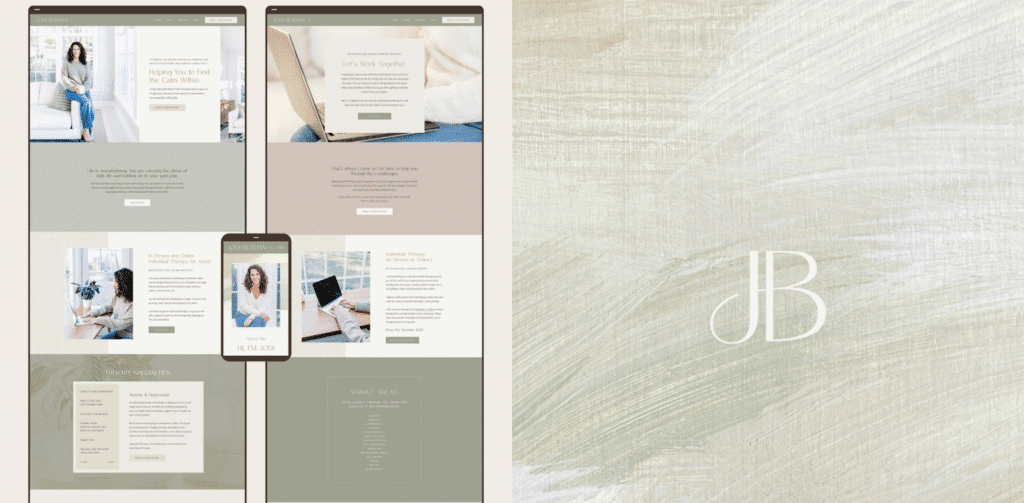
Jodi Berman, PhD, is a therapist based in Westport, Connecticut, supporting clients across the state through anxiety, depression, motherhood, and major life transitions.
Jodi wanted her website to feel calm, clean, and sophisticated in a way that would resonate with her ideal clients. I designed her brand and Showit website with an organic modern style, meaning warm tones, grounded textures, and a layout that’s peaceful and easy to navigate.
It’s optimized for SEO, and there’s a HIPAA-compliant contact form to get in touch with Jodi.
Community Connections Therapy
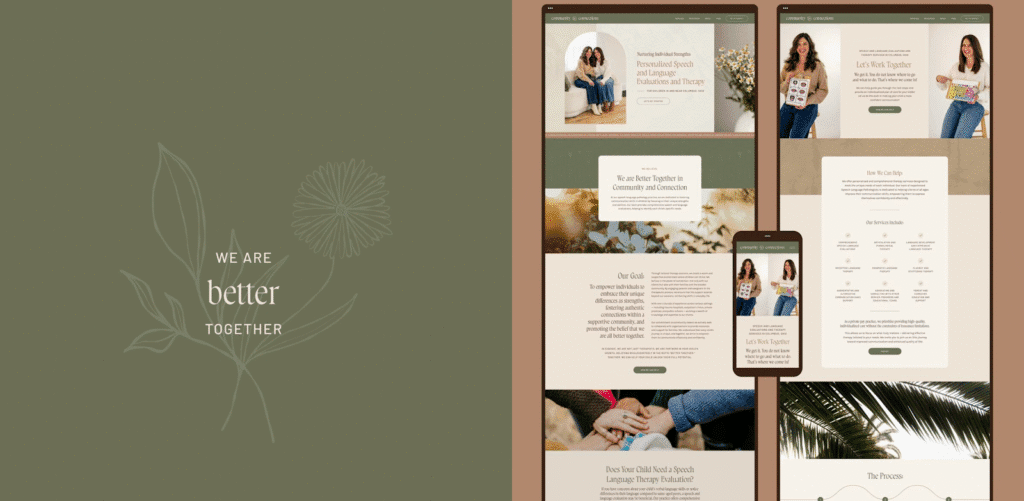
Community Connections Therapy is a speech and language therapy practice in Columbus, Ohio, founded by twin sisters Victoria and Christina. Their brand needed to feel earthy, welcoming, and boho-inspired, with a strong emphasis on diversity and community.
I designed a custom logo featuring a diverse collection of plants as a visual symbol of the inclusive community they’re building. The Showit website creates a cohesive experience that feels rooted and empowering, and there’s a branded HIPAA-compliant contact form!
The Vibrant Tapestry
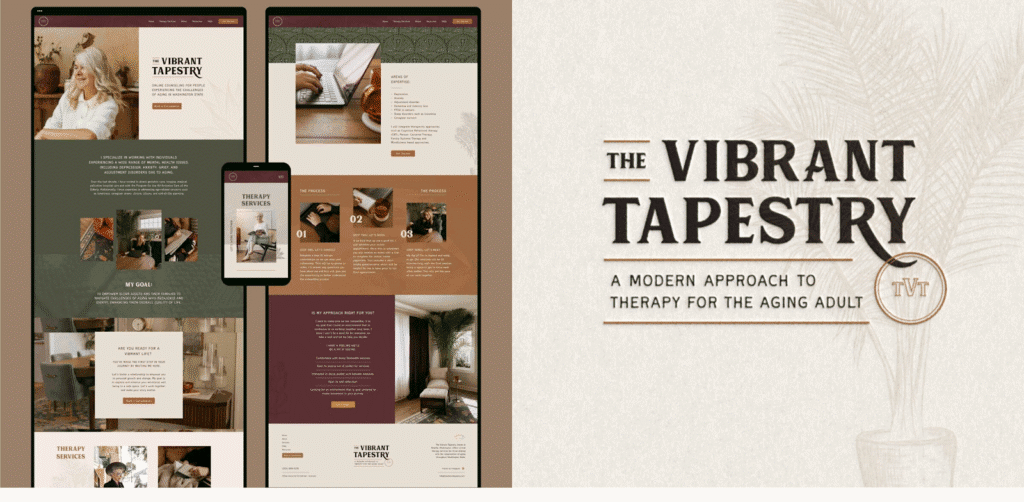
The Vibrant Tapestry is an online therapy practice for aging adults in Washington state. Renee’s mission is to honor her clients’ unique stories and support them through the complexities of aging.
The brand and website needed to feel warm, nurturing, and grounded, but also make it easy for potential clients to find key information. I designed a brand identity with earthy, peaceful tones and a Showit website that reflects the care and intentionality Renee brings to her practice.
Get Meaningful Health and Wellness Website Design
If you’re a health and wellness professional who wants a website that reflects your expertise, connects with your ideal clients, and supports the growth of your practice, I’d love to work with you!
I design custom brands and Showit websites for practitioners in this space, with a focus on strategy, SEO, HIPAA compliance, and design that feels aligned with who you are and how you work.
Learn more about my design services or get in touch to start a conversation about your project!


